Tuesday, April 25, 2006

Two Sides of Belief


Anonymous wrote, regarding the author of a blog I read regularly:

"you lost a lot of belief and you have lost faith but not compliteley. How do you do that? don't you believe or not believe? i know we can have lotsa doubts, but don't you either believe or not believe?losing heart and losing confidence make sense, but not really losing belief. am I totally crazy here?"

I then added my two cents:

No, Anonymous, you are anything but crazy! You have pointed out a critical aspect of our faith.

Here's what Tom Morris says about faith/belief in Philosophy For Dummies: (Incidentally, Morris is a Christian who taught at Notre Dame for 15 years to packed classrooms.)

"There are two sides to belief, a SUBJECTIVE side and an OBJECTIVE side. The subjective side is just the mental state of conviction. The objective side is the content of what is believed, a claim or representation about reality that philosophers refer to as a proposition."

So belief has a "what" side and a "how" side. The "what" is that objective side, that grounds us and keeps us from sinking under the tempests of our emotions. The "how" side is the subjective side, the part that transforms the truth of objective content/claims into "live," personal, experienced/passionate truth.

Our Enemy (Satan) is constantly alert to ways to get us off balance. One of his favorite ways is to get us to think that belief is simply assenting to objective claims, and ignoring the subjective dimension. James has nailed this one, in James 2:19, when he writes,

"You believe there is one God. Good! Even the demons believe that--and shudder."

So it is not enough to just intellectually affirm what is true. We need to trust Jesus, the Person who is Truth. Demons can't do that, so that is why they shudder.

But the Enemy also has another strategy: to get us off balance by making us focus on ourselves, instead of on Jesus. His first strategy works really well among fundamentalists, who think that what is most important is our heads, not our hearts. His second strategy works really well among postmodernists and existentialists, who think that what is primary in us is our hearts, not our heads.

So this second strategy is to make us focus on our own doubts and feelings, and hold the lie that "if we don't feel it isn't true." That is to make belief only about How and ignore the importance of What. Either way, the Enemy wins.

Again, James counsels: "Consider it pure joy, my brothers and sisters, whenever you face trials of many kinds, because you know that the testing of your faith develops perseverance. Perserverance must finish its work so that you may be mature and complete, not lacking anything."

Mature faith involves BOTH head and heart, which then are able to work together to produce fruits, the habits of character and good works that mark us as disciples of Jesus Christ.


Monday, April 10, 2006

Am I a Helper or an Enabler?


Sometimes 'Helping' Doesn't Help at All

from http://alcoholism.about.com/cs/info2/a/aa052197.htm

Many times when family and friends try to "help" alcoholics, they are actually making it easier for them to continue in the progression of the disease.

This baffling phenomenon is called enabling, which takes many forms, all of which have the same effect -- allowing the alcoholic to avoid the consequences of his actions. This in turn allows the alcoholic to continue merrily along his drinking ways, secure in the knowledge that no matter how much he screws up, somebody will always be there to rescue him from his mistakes.

What is the difference between helping and enabling? There are many opinions and viewpoints on this, some of which can be found on the pages linked below, but here is a simple description:

Helping is doing something for someone that they are not capable of doing themselves.


Enabling is doing for someone things that they could, and should be doing themselves. Simply, enabling creates a atmosphere in which the alcoholic can comfortably continue his unacceptable behavior.


Are you an enabler?Here's a few questions that might help determine the difference between helping and enabling an alcoholic in your life:

1. Have you ever "called in sick" for the alcoholic, lying about his symptoms?
2. Have you accepted part of the blame for his (or her) drinking or behavior?
3. Have you avoided talking about his drinking out of fear of his response?
4. Have you bailed him out of jail or paid for his legal fees?
5. Have you paid bills that he was supposed to have paid himself? 6. Have you loaned him money?
7. Have you tried drinking with him in hopes of strengthening the relationship?
8. Have you given him "one more chance" and then another and another?
9. Have you threatened to leave and didn't?
10. Have you finished a job or project that the alcoholic failed to complete himself?

Of course, if you answered "yes" to any of these questions, you at some point in time have enabled the alcoholic to avoid his own responsibilities. Rather than "help" the alcoholic, you have actually made it easier for him to get worse.

If you answered "yes" to most or all of these questions, you have not only enabled the alcoholic, you have probably become a major contributor to the growing and continuing problem and chances are have become effected by the disease yourself.

As long as the alcoholic has his enabling devices in place, it is easy for him to continue to deny he has a problem -- since most of his problems are being "solved" by those around him. Only when he is forced to face the consequences of his own actions, will it finally begin to sink in how deep his problem has become.
Some of these choices are not easy for the friends and families of alcoholics. If the alcoholic drinks up the money that was supposed to pay the utility bill, he's not the only one who will be living in a dark, cold, or sweltering house. The rest of the family will suffer right along with him.

That makes the only option for the family seem to be taking the money intended for groceries and paying the light bill instead, since nobody wants to be without utilities.

But that is not the only option. Taking the children to friends or relatives, or even a shelter, and letting the alcoholic come home alone to a dark house, is an option that protects the family and leaves the alcoholic face-to-face with his problem.

Those kinds of choices are difficult. They require "detachment with love." But it is love. Unless the alcoholic is allowed to face the consequences of his own actions, he will never realize just how much his drinking has become a problem -- to himself and those around him.

Thursday, April 06, 2006

Maybe it's Lent, maybe it's me...


It seems like everyone around me lately wants to hear a gospel of optimism and good times ahead, how God is going to make each of us individually happy and fulfilled. Soon, and very soon, here right now. Maybe its Lent, maybe its me, but I'm not seeing that gospel in Scripture. Instead, I hear "take up your cross." "We're going to Jerusalem." "I must die and rise again."

I have a bleak sort of hope, hope that someday everything will be set straight; but I'm not expecting it anytime soon. That's probably a lack of faith on my part, but there you have it.

For me, the good news is not that God is going to conform to my desires, but that through Christ, I can be conformed to Him. "Thy kingdom come, thy will be done." It doesn't say a whole lot there about my will.

I'm coming to think this perspective may have a lot to do with the generation I'm from. Many of my students and others younger than me have a negative notion of conforming to any standard or Person outside of themselves. Is this perhaps because of rampant metaphysical, epistemological and moral relativism which is engulfing us, and leading to their general skepticism ?

But for me, the good news is that now, when I find myself doing things I'd rather not do, and in the future, when I find myself in places I'd rather not be, I can be joyous, even if I'm not happy.

Earlier in my walk, I encountered the "Victorious Christian Life" folks, and knew I couldn't travel with them. Pain is real, not an illusion. Now I am encountering the "Jesus Loves Me Too Much to Hurt Me" crowd, and I can't go that way either. Sin is real, and it can't be ignored.

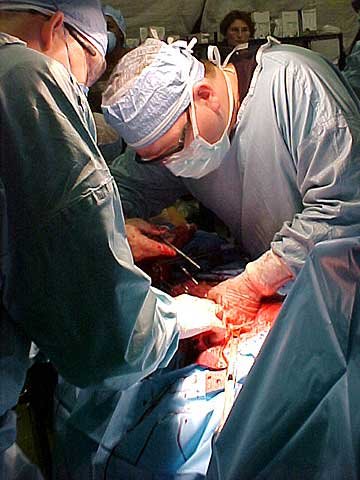
Jesus isn't a "nice guy." He isn't a tame lion. He is a surgeon. And--in order to heal--surgeons slice into living flesh.

A Lenten Meditation


Only the dead can be resurrected.

Only Jesus can resurrect the dead.

"I tell you the truth, unless a kernel of wheat falls to the ground and dies, it remains only a single seed. But if it dies, it produces many seeds. The man who loves his life will lose it, while the man who hates his life in this world will keep it for eternal life. Whoever serves me must follow me,and where I am, my servant will also be. My father will honor the one who serves me..." (John 12:24-26)

Dietrich Bonfhoeffer wrote in his book The Cost of Discipleship, "When Christ calls a man, he bids him come and die." This isn't a popular view for human beings, muchless Americans, muchless American Protestant evangelicals. We don't want to suffer. If we have to have them, we want our crosses empty and clean. We want to serve Christ yet follow our own selfish desires, and we want to follow those selfish desires rather than see them crucified. But if we want to have Christ's mind and heart, they inevitably must be crucified; indeed, they will be crucified. We can expect it.

He was a man of sorrows, and familiar with suffering (Isaiah 53:3)

So the only we can we can serve Christ (and not some other pretender) is to follow Him. And the only way to follow him is to be where He is. So we can't skip the part of the story where He goes to the cross. (Pretenders can, but we can't).

But look, its not an ordinary person on the rood--it is the Son of God!

So don't just have hope. Have hope in Jesus.
Don't just have peace. Have peace in Jesus.
Don't just have faith. Have faith in Jesus.

Its a paradox: turn your face to the cross, and you'll find life; and the life you will lead will be cruciform, like His.

In Him was life, and that light was the light of men. The light shines in the darkness, and the darkness has not overcome it. (John 1:4-5)