Thursday, July 29, 2010

Nominalism, the liberal arts, and education
If you're interested in the liberal arts, and/or the consequences of nominalism, here's something worth listening to: "Mars Hill Audio Journal," vol. 102, interview with Stratford Caldecott. Caldecott is head of the Center for Faith and Culture at the university of Oxford, and author of Beauty for Truth's Sake.
Ken Myers' introduction:
"The next segment features Stratford Caldecott on how beauty is linked to the inherent meaning in Creation. He talks about some of the concerns that led him to elaborate on this issue, especially his experiences of nominalism in the education system growing up. He notes that the steady disenchantment of the world has caused people to become insecure when it comes to matters of beauty and faith. If the world is meaningless apart from the meaning we impose on it, then faith and beauty become a matter of will rather than something objective and inherent within the structure of Creation. Caldecott discusses the implications of recovering the true character of Creation as a gift of love for our life of understanding."
Ken Myers' introduction:
"The next segment features Stratford Caldecott on how beauty is linked to the inherent meaning in Creation. He talks about some of the concerns that led him to elaborate on this issue, especially his experiences of nominalism in the education system growing up. He notes that the steady disenchantment of the world has caused people to become insecure when it comes to matters of beauty and faith. If the world is meaningless apart from the meaning we impose on it, then faith and beauty become a matter of will rather than something objective and inherent within the structure of Creation. Caldecott discusses the implications of recovering the true character of Creation as a gift of love for our life of understanding."
Sunday, July 25, 2010
A Prayer for Growing Old Gracefully

I came across this prayer tonight. God help me to grow old in His grace!
Lord,
Thou knowest better than I myself that I am growing older and will someday be old. Keep me from the fatal habit of thinking I must say something on every subject and on every occasion.
Release me from craving to straighten out everybody's affairs. Make me thoughtful but not moody; helpful but not bossy. With my vast store of wisdom, it seems a pity not to use it all; but Thou knowest, Lord, that I want a few friends at the end. Keep my mind free from the recital of endless details; give me wings to get to the point. Seal my lips on my aches and pains; they are increasing, and love of rehearsing them is becoming sweeter as the years go by.
I dare not ask for improved memory, but for a growing humility and a lessening cock-sureness when my memory seems to clash with the memories of others. Teach me the glorious lesson that occasionally I may be mistaken.
Keep me reasonably sweet, for a sour old person is one of the crowning works of the devil. Give me the ability to see good things in unexpected places and talents in unexpected people; and give, O Lord, the grace to tell them so.
Amen.
---Author Unknown
Lord,
Thou knowest better than I myself that I am growing older and will someday be old. Keep me from the fatal habit of thinking I must say something on every subject and on every occasion.
Release me from craving to straighten out everybody's affairs. Make me thoughtful but not moody; helpful but not bossy. With my vast store of wisdom, it seems a pity not to use it all; but Thou knowest, Lord, that I want a few friends at the end. Keep my mind free from the recital of endless details; give me wings to get to the point. Seal my lips on my aches and pains; they are increasing, and love of rehearsing them is becoming sweeter as the years go by.
I dare not ask for improved memory, but for a growing humility and a lessening cock-sureness when my memory seems to clash with the memories of others. Teach me the glorious lesson that occasionally I may be mistaken.
Keep me reasonably sweet, for a sour old person is one of the crowning works of the devil. Give me the ability to see good things in unexpected places and talents in unexpected people; and give, O Lord, the grace to tell them so.
Amen.
---Author Unknown
Sunday, July 18, 2010
Whom Do You Write Like?
Check which famous writer you write like with the statistical analysis tool here at "I Write Like." It analyzes your word choice and writing style and compares them with those of the famous writers.
I plugged in a bit and got this:

Then I plugged in a second piece, and got this! : O
I plugged in one of Steve's sermons, and it says he writes like George Orwell. SO much for these trivial pursuits!
I plugged in a bit and got this:
I write like
William Shakespeare
William Shakespeare
I Write Like by Mémoires, Mac journal software. Analyze your writing!
Then I plugged in a second piece, and got this! : O
I plugged in one of Steve's sermons, and it says he writes like George Orwell. SO much for these trivial pursuits!
Saturday, July 17, 2010
"Tea party Jesus"


Here's a blog that Christians need to stop feeding. You can find the sources of the quotes by going to the blog and clicking on the photo. I don't know which is more alarming: the quotes, or the artwork.


Thursday, July 15, 2010
The Frock: Escapist Female Fun
I now present a real escapist site for women... The Frock .It includes antique, vintage and couture dresses for sale, from the Victorian age to the present. Many look like they belong in museums.
Ever since we were in York,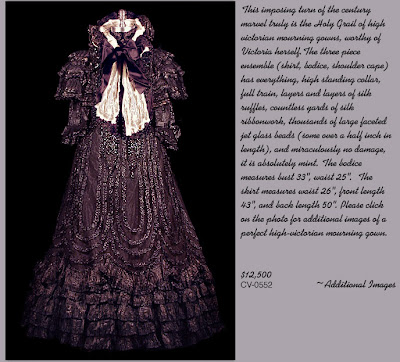
and I got to see an exhibit on Birth and Death in Victorian England, I have been fascinated with mourning gowns. Here is an extraordinary one: -->
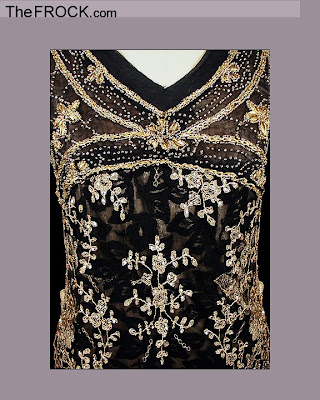
<-- This one is not a mourning gown, but it is my favorite. Look at that extraordinary beading! That sort of skill is almost impossible to recreate. And here is a blue flapper style, also with beautiful art-nouoveau hand-beading. I would not be ashamed to be seen wearing it today.

There are many, many more dresses, including bridal gowns, and designer pieces by Versace, Valentino, Cardin, Armani, de la Renta, Galanos, Balenciaga, Mary Quant, Norell, Hartnell, Givenchy, Geoffrey Beane, Oleg Cassini, Pauline Trigere, Adrian, and Teal Traina.
On the whole, I find the mid-century gowns the hardest to imagine wearing (with the exception of the Halstons and a couple by Mme. Gres.) Perhaps that is because I grew up when a lot of those looks were on their way out!
Ever since we were in York,

and I got to see an exhibit on Birth and Death in Victorian England, I have been fascinated with mourning gowns. Here is an extraordinary one: -->

<-- This one is not a mourning gown, but it is my favorite. Look at that extraordinary beading! That sort of skill is almost impossible to recreate. And here is a blue flapper style, also with beautiful art-nouoveau hand-beading. I would not be ashamed to be seen wearing it today.

There are many, many more dresses, including bridal gowns, and designer pieces by Versace, Valentino, Cardin, Armani, de la Renta, Galanos, Balenciaga, Mary Quant, Norell, Hartnell, Givenchy, Geoffrey Beane, Oleg Cassini, Pauline Trigere, Adrian, and Teal Traina.
On the whole, I find the mid-century gowns the hardest to imagine wearing (with the exception of the Halstons and a couple by Mme. Gres.) Perhaps that is because I grew up when a lot of those looks were on their way out!


Monday, July 12, 2010
Broken Brick Recycling
A former student friend wrote on Facebook:
"Spiritual realities come through experience. Otherwise you just have spiritual theories."
My response:
But how do you determine whether what you are experiencing is real/true/good or not? That is why I am fond of what has been called the Wesleyan Quadrilateral: Scripture, tradition, reason and experience are ALL necessary. Each one of these is necessary for our life in Christ, but apart from the others it is insufficient.
Life in Christ is like a brick, out of which Christ forms His Kingdom. Each brick has those four corners: Scripture, tradition, reason and experience. If any one of those corners is overemphasized, the brick will be out of kilter. Instead of being a rectangle, it will be a trapezoid, and so harder to build with. Jesus is in the process of recycling broken bricks and rebuilding His kingdom, which was bombed by Satan.
Here is a Korean "Broken Brick Recycling Machine." (Look here for more information.)
However, unlike the Korean machine, Christ's restoration is personal, not mechical.
The mystery of our faith is that He is building His kingdom out of our brokenness, but at the same time He is building, He is scraping away or extending us so that, more and more, we become strong, stable blocks.
Some of us need more knowledge of Scripture; so His Holy Spirit prompts us to "take up and read!"
Some of us need to discover the Church throughout time and space, and the traditions of the community that has shaped us, so His Holy Spirit urges us to remember and pass on that which we have received.
Some of us too easily dismiss the life of the mind, so His Holy Spirit encourages us to better understand and defend our faith.
And some of us, as my student opined, are too comfortable with theory, so His Holy Spirit urges us to act and to be acted upon.
.
"Spiritual realities come through experience. Otherwise you just have spiritual theories."
My response:
But how do you determine whether what you are experiencing is real/true/good or not? That is why I am fond of what has been called the Wesleyan Quadrilateral: Scripture, tradition, reason and experience are ALL necessary. Each one of these is necessary for our life in Christ, but apart from the others it is insufficient.
Life in Christ is like a brick, out of which Christ forms His Kingdom. Each brick has those four corners: Scripture, tradition, reason and experience. If any one of those corners is overemphasized, the brick will be out of kilter. Instead of being a rectangle, it will be a trapezoid, and so harder to build with. Jesus is in the process of recycling broken bricks and rebuilding His kingdom, which was bombed by Satan.
Here is a Korean "Broken Brick Recycling Machine." (Look here for more information.)
However, unlike the Korean machine, Christ's restoration is personal, not mechical.
The mystery of our faith is that He is building His kingdom out of our brokenness, but at the same time He is building, He is scraping away or extending us so that, more and more, we become strong, stable blocks.
Some of us need more knowledge of Scripture; so His Holy Spirit prompts us to "take up and read!"
Some of us need to discover the Church throughout time and space, and the traditions of the community that has shaped us, so His Holy Spirit urges us to remember and pass on that which we have received.
Some of us too easily dismiss the life of the mind, so His Holy Spirit encourages us to better understand and defend our faith.
And some of us, as my student opined, are too comfortable with theory, so His Holy Spirit urges us to act and to be acted upon.
.
Leadership Poll: How Protestants celebrate July 4


Okay, so it's a self-selecting sample, but does anyone else find this Leadership poll disturbing? I've always thought that when Protestants jettison the church calendar, they fill the vacuum with secular "holy" days. Seems like this might provide some evidence for my theory.
How did your church recognize the 4th of July holiday?
7% said "It's not a holy day. We didn't recognize it."
20% said "A verbal recognition, little else."
20% said "A prayer for the nation."
9% said "It was the sermon's focus."
44% said "Patriotic hymns, sermon, visuals ... God bless the U.S.A.!"
Total Votes: 303
Sunday, July 11, 2010
Fences or Wells? Billiard balls or sponges?

(Via Brad)
John Ortberg has found yet another way to express our ecclesiological crisis, in terms of "bounded sets" or "fences," and "centered sets" or "wells." But the metaphysics behind his metaphors and mine are the same: which best describes the world? Nominalism, or some sort of metaphysical Realism?
As I've written elsewhere ( here and here and here ) nominalists deny universals, and in so doing they cannot account for participation, relationship and "nearness or farness." Because nominalists see things as discrete individuals, persons are billiard balls on the Great Pool Table of Life. Billiard balls can only be collected by means of a rack, which "fences" them into an artificial grouping. The ball is either "in" or "out." But Platonists, Aristotelians and Thomists allow for both individuals and universals, and so are able to handle and express genuine relationships. 
Ortberg's well metaphor is rich in this context, but I also like to think of persons as those little dry compressed sponges, increasingly soaking up Christ's Living Water; growing in their capacity to absorb His truth and goodness, and to blot out sin and injustice.

Ortberg's well metaphor is rich in this context, but I also like to think of persons as those little dry compressed sponges, increasingly soaking up Christ's Living Water; growing in their capacity to absorb His truth and goodness, and to blot out sin and injustice.
Category Confusion
Is the question for Christians "Out or In?" or "Farther or Closer?"
John Ortberg, in Leadership Journal.net
Not long ago I was at a church in the South and a recent convert named Mike told me he had a bone to pick with the church. He was drawn to Christianity by the message of grace. "I was told that being a Christian wasn't about anything I had to do; it was about a sacrifice that had already been done on my behalf. But now that I'm on the inside, I'm told I have to do stuff all the time. I have to go to church, I have to read the Bible, I have to give money, I have to volunteer.
"I feel like the victim of a bait-and-switch."
So I had him read an article on bounded-vs.-centered sets by anthropologist Paul Hiebert titled "Sets and Structures: A Study in Church Patterns."
Not really. I'm not sure it's quite right for Mike. But it is a real article, and it sheds light on Mike's problem in a brilliant way.
Paul (Hiebert, not the apostle) said that much of how we approach church and the spiritual life depends on our deep assumptions about what it means to be Christian. He talked about two different categories, or "sets," we use to understand being a Christian.
A bounded set is one where all its members are determined by focusing on the boundary. For instance, "apples" is a bounded set. Whether or not an item fits depends on whether it meets the criteria for apples—having skin and seeds and so on. Membership in a bounded set is static. Whether you're a rotten apple or a ripe apple does not affect your appleness. The focus is not on movement but position.
A centered set, on the other hand, is determined by a focus on the center. For example, "bald-headed people" would be a centered set. The paradigmatic member would be Mr. Clean, at the center of the set.
Centered sets are dynamic, in motion. A baby might be born with no hair, but hair is coming, so that baby may start near the center but moves away and eventually is out of the category. On the other hand, a 20-year-old might have hair, but it's already starting to stay on the comb, so he's on his way into the category.
With centered sets, the key question is whether I am oriented and moving toward the center or moving away from the center. I'm defined on where I am, and where I'm moving, in relation to the center.
When I read this, it helped me understand the problem Mike (and so many churches) face.
If we treat Christianity as a bounded set, there will always be a disconnect between the gospel and discipleship. The gospel will be presented as something to get you "inside the circle." Once you're inside, we don't want to say you have to do anything to stay in (that would be salvation by works). But we don't want to say you don't have to do anything (the triumph of entropy, or, to use a biblical word, being lukewarm, or to use a theological word, antinomianism). So we don't know what to say.
However, if we treat Christianity as a centered set, the relationship between the gospel and discipleship becomes much clearer. The gospel is the proclamation that life with and through Jesus is now available to ordinary people. It is a free gift of forgiveness and grace that cannot be earned. If I want it, the way that I enter into it is by becoming a follower of Jesus and orienting our lives with him at the center.
The problem with a bounded-set approach to Christianity is not that it highlights the difference between Christians and non-Christians; it's that it highlights the wrong differences, and encourages us to exaggerate and claim differences that don't exist. For instance, Jesus had a lot to say about concern for the poor. But if we think that non-Christians are also concerned for the poor, we won't focus on it much because it doesn't highlight "how we are different."
If we focus on Jesus as the center, then the key question becomes whether someone is oriented toward him or away from him. We realize that God is in a much better position than we are to know who's in and who's out. We also realize that everyone has something to learn, that everyone has a next step to take, and we don't have to make ourselves seem more different than we really are. We embrace our common humanity.
Somebody wrote that in Australia there are two main methods for keeping cattle on the ranch. One is to build a fence around the perimeter. The other is to dig a well in the center of the property.
I think Jesus is more like a well than a fence.
John Ortberg is pastor of Menlo Park (California) Presbyterian Church and an editor at large of Leadership.
Friday, July 09, 2010
The "I Hate Summer" Song

(To the tune of "I love Paris")
I hate summer in the winter.
I hate summer in the fall.
I hate summer in the springtime, when it drizzles;
I hate summer in the summer, when it sizzles.
I hate summer every moment--
With each breath and each heart beat.
I hate summer,
my oh my, do I hate summer!
I just can’t take this heat!
Wednesday, July 07, 2010
Giant Klein Bottle: $18,000

I wish I could get one Klein bottle for Kaylee and one for David.
They are all one surface: "Its inside is its outside. It contains itself."
Here's how they are made
Here's everything you could ever want to know about them.
Tres cool!
Sunday, July 04, 2010
Independence Day in Siberia and Eugene, OR

Hilary Krieger presents a moving reflection on Independence Day, as a day to thank God for the blessings He has given us in this country. As Scot McKnight writes,
"I don't want churches to honor America, and I don't want churches to give glory to war or warriors, and I don't want the flag to gain any semblance of iconic or liturgical value. I want to give glory to God, the God who brings justice, and who gathers us justice-shaped and peace-shaped people of God's together to celebrate and to worship."
Today we also have the opportunity to welcome others into these blessings, and to share them with future generations. Today we have the chance to work for "justice for all." It is a gift to be an American; but it is an even greater gift to be a citizen in the Kingdom of God. That citizenship bears a freedom which no man can seize, and no nation can give.
"I don't want churches to honor America, and I don't want churches to give glory to war or warriors, and I don't want the flag to gain any semblance of iconic or liturgical value. I want to give glory to God, the God who brings justice, and who gathers us justice-shaped and peace-shaped people of God's together to celebrate and to worship."
Today we also have the opportunity to welcome others into these blessings, and to share them with future generations. Today we have the chance to work for "justice for all." It is a gift to be an American; but it is an even greater gift to be a citizen in the Kingdom of God. That citizenship bears a freedom which no man can seize, and no nation can give.
So this morning, we won't be singing "God bless America" or "America the Beautiful" in worship, but we will be receiving the Body and Blood of Christ. And I will be grateful.
"I am the Lord thy God, which have brought thee out of the land of Egypt, out of the house of bondage. Thou shalt have no other gods before me." (Exodus 20:1-3)
Independence Day in Siberia
By HILARY KRIEGER
My "there but for the grace of God" moment came on March 30, 2005. On that day, I found myself in the musty, bare apartment of 75-year-old Josef Katz, a former Soviet army truck driver who lived in the industrial wasteland of Achinsk, Siberia.
I had come to learn about the Jewish aid organization that provided him basic necessities each week, but what touched me most wasn't his present poverty. It was the story he told me about his past, of the steps that carried him to a cramped and crumbling apartment with a vista limited to the concrete courtyard separating his warehouse of a building from the others just like it—and how it could have been my own family's.
Like the many political prisoners who made Siberia synonymous with exile, Katz was born elsewhere. In his case, it was Ukraine, where he lived in a small town until World War II. Then, in 1944, he was packed onto a train, sent to a concentration camp and separated from his family. He managed to hang on until the next year when, at the age of 15, he was liberated by American soldiers.
Being just a boy, when the GIs—"angels" he called them—offered to take him to the United States, he thought only of finding his parents. So he turned down the soldiers' offer. Half-starved and penniless, Katz could barely walk. Yet he made it back home, where he discovered that he alone from his family had survived.
There was a neighbor who recognized him and took him in. She spent a year nursing him back to health, and he in turn spent two years after that working to repay her. By then he was old enough to realize what he had lost by not going to America. But it was too late. He entered his mandatory military service in the Soviet army and was sent to a base in Siberia.
After his release Katz found work as a driver in Achinsk, where the grayness of the buildings, streets and perpetual slush penetrates the bones more deeply than the chill. It was in Achinsk that he, as he put it, "lived, worked and grew old."
Katz's decision was long made by the time I met him in his apartment five years ago. But that didn't mean the wound of a life that might have been wasn't fresh. When I asked him whether he regretted his choice, tears welled up.
"It was the biggest mistake I ever made," he answered. "Many times I was crying in my heart that I missed that chance."
My eyes weren't dry, either. But I can't claim it was solely compassion that moved me. It was also deep gratitude.
My own family lived in parts of Eastern Europe that later came under Soviet control. And they, too, were buffeted by historic forces of tragedy and opportunity.
The discrimination and hardship visited on Jews in the Czarist army caused my great-grandfather's parents to have him smuggled out of Russia at the age of 14 before he could be conscripted. Against a backdrop of anti-Jewish pogroms, the prospect of building a better life convinced my great-great-grandmother to sell her home so that she, her husband and their 10 children could join the huddled masses reaching the New York shore in 1895.
Had they wavered, they and their offspring would also have grown up to face the ravages of World War II and—had any survived—a life of stifled hopes under Soviet Communism.
As their descendant, I would not have had the superlative public education where even as a student journalist I was able to test the bounds of free speech. I would not have gained the entrée and financial aid at Cornell, one of the country's finest universities, that opened the door to the career of my choice. I would not have been able to worship freely as a Jew, to recite the Passover declaration loudly and publicly that "on this festival of freedom we pray that liberty will come to all."
On Independence Day, I am acutely aware of the remarkable gifts I have been given because of decisions my forebears made, risks they took because of their conviction that America would receive and favor them. Because they were able to seize opportunity rather than let it slip away.
In a godforsaken apartment in Achinsk, I understood the blessings of being an American.
Ms. Krieger is the Washington bureau chief of the Jerusalem Post.
Independence Day in Siberia
By HILARY KRIEGER
My "there but for the grace of God" moment came on March 30, 2005. On that day, I found myself in the musty, bare apartment of 75-year-old Josef Katz, a former Soviet army truck driver who lived in the industrial wasteland of Achinsk, Siberia.
I had come to learn about the Jewish aid organization that provided him basic necessities each week, but what touched me most wasn't his present poverty. It was the story he told me about his past, of the steps that carried him to a cramped and crumbling apartment with a vista limited to the concrete courtyard separating his warehouse of a building from the others just like it—and how it could have been my own family's.
Like the many political prisoners who made Siberia synonymous with exile, Katz was born elsewhere. In his case, it was Ukraine, where he lived in a small town until World War II. Then, in 1944, he was packed onto a train, sent to a concentration camp and separated from his family. He managed to hang on until the next year when, at the age of 15, he was liberated by American soldiers.
Being just a boy, when the GIs—"angels" he called them—offered to take him to the United States, he thought only of finding his parents. So he turned down the soldiers' offer. Half-starved and penniless, Katz could barely walk. Yet he made it back home, where he discovered that he alone from his family had survived.
There was a neighbor who recognized him and took him in. She spent a year nursing him back to health, and he in turn spent two years after that working to repay her. By then he was old enough to realize what he had lost by not going to America. But it was too late. He entered his mandatory military service in the Soviet army and was sent to a base in Siberia.
After his release Katz found work as a driver in Achinsk, where the grayness of the buildings, streets and perpetual slush penetrates the bones more deeply than the chill. It was in Achinsk that he, as he put it, "lived, worked and grew old."
Katz's decision was long made by the time I met him in his apartment five years ago. But that didn't mean the wound of a life that might have been wasn't fresh. When I asked him whether he regretted his choice, tears welled up.
"It was the biggest mistake I ever made," he answered. "Many times I was crying in my heart that I missed that chance."
My eyes weren't dry, either. But I can't claim it was solely compassion that moved me. It was also deep gratitude.
My own family lived in parts of Eastern Europe that later came under Soviet control. And they, too, were buffeted by historic forces of tragedy and opportunity.
The discrimination and hardship visited on Jews in the Czarist army caused my great-grandfather's parents to have him smuggled out of Russia at the age of 14 before he could be conscripted. Against a backdrop of anti-Jewish pogroms, the prospect of building a better life convinced my great-great-grandmother to sell her home so that she, her husband and their 10 children could join the huddled masses reaching the New York shore in 1895.
Had they wavered, they and their offspring would also have grown up to face the ravages of World War II and—had any survived—a life of stifled hopes under Soviet Communism.
As their descendant, I would not have had the superlative public education where even as a student journalist I was able to test the bounds of free speech. I would not have gained the entrée and financial aid at Cornell, one of the country's finest universities, that opened the door to the career of my choice. I would not have been able to worship freely as a Jew, to recite the Passover declaration loudly and publicly that "on this festival of freedom we pray that liberty will come to all."
On Independence Day, I am acutely aware of the remarkable gifts I have been given because of decisions my forebears made, risks they took because of their conviction that America would receive and favor them. Because they were able to seize opportunity rather than let it slip away.
In a godforsaken apartment in Achinsk, I understood the blessings of being an American.
Ms. Krieger is the Washington bureau chief of the Jerusalem Post.
Subscribe to:
Posts (Atom)