Tuesday, May 23, 2006

"What we love will ruin us"


In my opinion, Aldous Huxley was partially right here (although unwittingly so!) IMO it is not that we are ruined by loving; rather, it is the case that we have been created to hold God as our first love, so ultimately loving anything less will ruin us. This is a book I want to read sometime soon.

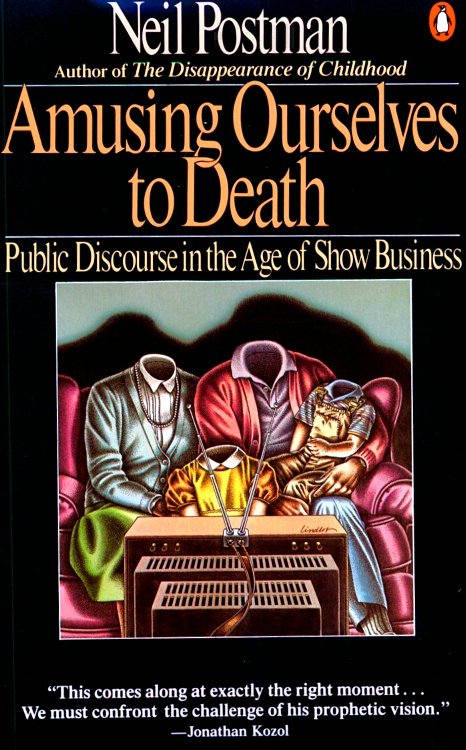
Foreword from Amusing Ourselves to Death

by Neil Postman

We were keeping our eye on 1984. When the year came and the prophecy didn't, thoughtful Americans sang softly in praise of themselves. The roots of liberal democracy had held. Wherever else the terror had happened, we, at least, had not been visited by Orwellian nightmares.

But we had forgotten that alongside Orwell's dark vision, there was another - slightly older, slightly less well known, equally chilling: Aldous Huxley's Brave New World. Contrary to common belief even among the educated, Huxley and Orwell did not prophesy the same thing. Orwell warns that we will be overcome by an externally imposed oppression. But in Huxley's vision, no Big Brother is required to deprive people of their autonomy, maturity and history. As he saw it, people will come to love their oppression, to adore the technologies that undo their capacities to think.

What Orwell feared were those who would ban books. What Huxley feared was that there would be no reason to ban a book, for there would be no one who wanted to read one. Orwell feared those who would deprive us of information. Huxley feared those who would give us so much that we would be reduced to passivity and egoism. Orwell feared that the truth would be concealed from us. Huxley feared the truth would be drowned in a sea of irrelevance. Orwell feared we would become a captive culture. Huxley feared we would become a trivial culture, preoccupied with some equivalent of the feelies, the orgy porgy, and the centrifugal bumblepuppy. As Huxley remarked in Brave New World Revisited, the civil libertarians and rationalists who are ever on the alert to oppose tyranny "failed to take into account man's almost infinite appetite for distractions". In 1984, Huxley added, people are controlled by inflicting pain. In Brave New World, they are controlled by inflicting pleasure. In short, Orwell feared that what we hate will ruin us. Huxley feared that what we love will ruin us.

This book is about the possibility that Huxley, not Orwell, was right.

Monday, May 15, 2006

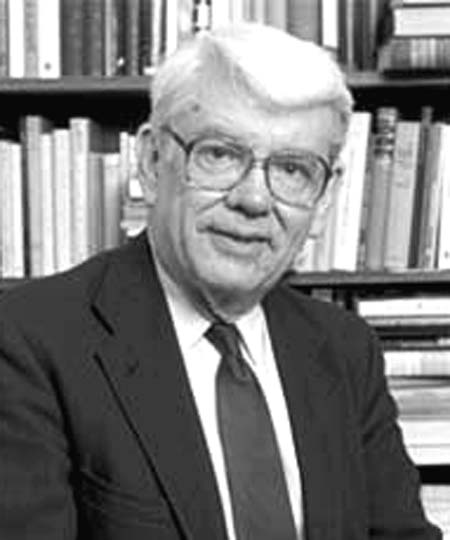
"I'm Filing a Minority Report on Behalf of the Past" --Jarosalv Pelikan dies at 82


By MATT APUZZO
ASSOCIATED PRESS WRITER


NEW HAVEN, Conn. -- Yale professor Jaroslav Pelikan, one of the world's foremost scholars of the history of Christianity, has died of lung cancer, his son said Monday. He was 82.

Pelikan wrote more than 30 books, using sources in nine languages and dealing with literary and musical as well as doctrinal aspects of religion."For a man as talented and accomplished as he was, he was also exceptionally kind and genuinely humble," said his son, Michael. "The more
he learned, the more amazed he was by how much he did not know."

Pelikan died Saturday at his home in Hamden, his son said.
A Lutheran convert to Eastern Orthodoxy, Pelikan was a former president of the American Academy of Arts and Sciences and was appointed by President Clinton to serve on the President's Committee on the Arts and Humanities.His works include the acclaimed five-volume text, "The Christian Tradition," which followed the story of Christianity from its origins to
modern times. Pelikan's "Whose Bible Is It?", published in 2005, explored how people of different faiths interpret the Bible. He said language and cultural differences led to varying interpretations of the Scripture.His conclusion, he said in an interview with National Public Radio last year, was that, "Christians and Jews need each other in an effort to
understand the sacred text they share."

Though renowned as an expert theologian, Pelikan preferred studying history and rarely waded into modern religious debates.
"There ought to be somebody who speaks to the other 19 centuries," he said in a 1983 interview with the Christian Science Monitor. "Not everybody should be caught in this moment. I'm filing a minority report on behalf of the past."

Pelikan joined the Yale faculty in 1962 and later was designated a Sterling professor, an honor reserved for the university's most
distinguished professors.The National Endowment for the Humanities selected Pelikan in 1983 to deliver the Jefferson Lecture in the Humanities, the highest honor the federal government confers for achievement in the humanities. He twice delivered the Guifford Lectures in Scotland, considered one of the foremost lecture series dealing with religion, science and philosophy. He also founded the Council of Scholars at the Library of Congress in 1980.

In 2004, Pelikan and 91-year-old French philosopher Paul Ricoeur shared the $1 million Kluge prize that honors scholars in such areas as history, sociology and anthropology - fields not covered by the Nobel prizes.Also that year, Pelikan published a book comparing the way the Bible and the U.S. Constitution have been understood and applied. The book, "Interpreting the Bible and the Constitution," cited 72 Supreme Court rulings, 94 Christian creeds and numerous Bible verses.

Monday, May 08, 2006

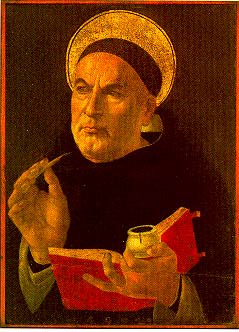
G.K. Chesterton: Chapter 7 from "St. Thomas Aquinas, the Dumb Ox"


In a sketch that aims only at the baldest simplification, this does seem to me the simplest truth about St. Thomas the philosopher. He is one, so to speak, who is faithful to his first love; and it is love at first sight. I mean that he immediately recognised a real quality in things; and afterwards resisted all the disintegrating doubts arising from the nature of those things. That is why I emphasise, even in the first few pages, the fact that there is a sort of purely Christian humility and fidelity underlying his philosophic realism. St. Thomas could as truly say, of having seen merely a stick or a stone, what St. Paul said of having seen the rending of the secret heavens, "I was not disobedient to the heavenly vision." For though the stick or the stone is an earthly vision, it is through them that St. Thomas finds his way to heaven; and the point is that he is obedient to the vision; he does not go back on it. Nearly all the other sages who have led or misled mankind do, on one excuse or another, go back on it. They dissolve the stick or the stone in chemical solutions of scepticism; either in the medium of mere time and change; or in the difficulties of classification of unique units; or in the difficulty of recognising variety while admitting unity. The first of these three is called debate about flux or formless transition; the second is the debate about Nominalism and Realism, or the existence of general ideas; the third is called the ancient metaphysical riddle of the One and the Many. But they can all be reduced under a rough image to this same statement about St. Thomas. He is still true to the first truth and refusing the first treason. He will not deny what he has seen, though it be a secondary and diverse reality. He will not take away the numbers he first thought of, though there may be quite a number of them.

He has seen grass; and will not say he has not seen grass, because it today is and tomorrow is cast into the oven. That is the substance of all scepticism about change, transition, transformism and the rest. He will not say that there is no grass but only growth. If grass grows and withers, it can only mean that it is part of a greater thing, which is even more real; not that the grass is less real than it looks. St. Thomas has a really logical right to say, in the words of the modern mystic, A. E.: "I begin by the grass to be bound again to the Lord."

He has seen grass and grain; and he will not say that they do not differ, because there is something common to grass and grain. Nor will he say that there is nothing common to grass and grain, because they do really differ. He will not say, with the extreme Nominalists, that because grain can be differentiated into all sorts of fruitage, or grass trodden into mire with any kind of weed, therefore there can be no classification to distinguish weeds from slime or to draw a fine distinction between cattle-food and cattle. He will not say with the extreme Platonists, on the other hand, that he saw the perfect fruit in his own head by shutting his eyes, before he saw any difference between grain and grass. He saw one thing and then another thing and then a common quality; but he does not really pretend that he saw the quality before the thing.

He has seen grass and gravel; that is to say, he has seen things really different; things not classified together like grass and grains. The first flash of fact shows us a world of really strange things not merely strange to us, but strange to each other. The separate things need have nothing in common except Being. Everything is Being; but it is not true that everything is Unity. It is here, as I have said, that St. Thomas does definitely one might say defiantly, part company with the Pantheist and Monist. All things are; but among the things that are is the thing called difference, quite as much as the thing called similarity. And here again we begin to be bound again to the Lord, not only by the universality of grass, but by the incompatibility of grass and gravel. For this world of different and varied beings is especially the world of the Christian Creator; the world of created things, like things made by an artist; as compared with the world that is only one thing, with a sort of shimmering and shifting veil of misleading change; which is the conception of so many of the ancient religions of Asia and the modern sophistries of Germany. In the face of these, St. Thomas still stands stubborn in the same obstinate objective fidelity. He has seen grass and gravel; and he is not disobedient to the heavenly vision.

To sum up; the reality of things, the mutability of things, the diversity of things, and all other such things that can be attributed to things, is followed carefully by the medieval philosopher, without losing touch with the original point of the reality. There is no space in this book to specify the thousand steps of thought by which he shows that he is right. But the point is that, even apart from being right he is real. He is a realist in a rather curious sense of his own, which is a third thing, distinct from the almost contrary medieval and modern meanings of the word. Even the doubts and difficulties about reality have driven him to believe in more reality rather than less. The deceitfulness of things which has had so sad an effect on so many sages, has almost a contrary effect on this sage. If things deceive us, it is by being more real than they seem. As ends in themselves they always deceive us; but as things tending to a greater end, they are even more real than we think them. If they seem to have a relative unreality (so to speak) it is because they are potential and not actual; they are unfulfilled, like packets of seeds or boxes of fireworks. They have it in them to be more real than they are. And there is an upper world of what the Schoolman called Fruition, or Fulfilment, in which all this relative relativity becomes actuality; in which the trees burst into flower or the rockets into flame.

Here I leave the reader, on the very lowest rung of those ladders of logic, by which St. Thomas besieged and mounted the House of Man. It is enough to say that by arguments as honest and laborious, he climbed up to the turrets and talked with angels on the roofs of gold. This is, in a very rude outline, his philosophy; it is impossible in such an outline to describe his theology. Anyone writing so small a book about so big a man, must leave out something. Those who know him best will best understand why, after some considerable consideration, I have left out the only important thing.

selection from http://www.dur.ac.uk/martin.ward/gkc/books/aquinas.html#chap7

Wednesday, May 03, 2006

Worship: A Matter of Being...


In response to a blog entry saying that God doesn't "need" us, and that worship is therefore really about us....

IMO it may be true that God doesn't NEED us, but surely he WANTS us. That makes all the difference, because it means that worship is not just about us, but about the deepening of a love affair--one in which He is the Lover, and we are His beloved.
Furthermore, it is about the overflow of that love, which births a community--the church, the Body of Christ.

That is why I can't understand how anyone who is a Christian wouldn't want to be together with Him and His people in worship. What else could possibly be more important to us? What else could command our attention and presence? As my favorite theologian, Thomas Aquinas once said, "any good which isn't completely sharable is a small good." The amazing thing about worship is that it is a completely sharable good--involving God, me, and others.

All this involves some difficult questions, I know; and indeed, the Sabbath was made for man, not man for the Sabbath. But in the end, Sabbath is about loving, and acknowledging whether our first love will be a Who or a what.

Another way to think of worship is as a dress rehearsal, or a practice for our life together with the Lord, eternally in that state called "heaven." We wouldn't think of putting on a play without a rehearsal; we wouldn't think of going to an ultimate tournament without putting in lots of time practicing and perfecting our game. Well, the same thing applies to worship.

That is why when we are absent from worship, for whatever reason, God(Father/Son/Spirit) suffers. Christ's Body, the Church, suffers. A love affair can't be consummated if one of the lovers isn't present. God the Trinity is already and always there; the question is, where will we be, physically, emotionally,and intellectually?

Worship, then, is about us only because it is first about Him:

We love, because He first loved us. (1 John 4:19)

Dear children, let us not love with words or tongue but with actions and in truth. This then, is how we know that we belong to the truth, and how we set our hears at rest in his presence...(1 John 3:18-19)

So here's a challenge: what is it that is keeping us from assembling together, from encountering Him and each other? Is it boredom? Is it work? Is it school? Is it unbelief? Is it a sports event? How will we change that? Because worship is not just about us and what we want. It's about being WANTED.